Third molars
Wisdom Tooth Extraction
Removal of impacted or crowded wisdom teeth. The practice describes this treatment as painless.
Why they cause trouble
Wisdom teeth are the third molars, the last teeth to come through, usually in the late teens or twenties. There is often not enough room left at the back of the jaw for them, so they come through partly, at an angle, or not at all. A tooth in that position is described as impacted.
A partly erupted wisdom tooth has a flap of gum over part of it that traps food and bacteria and cannot be cleaned. That leads to repeated painful infections of the gum around it. An angled wisdom tooth can also press against the molar in front, causing decay on a surface that cannot be reached to fill, or in some cases resorbing its root. Not every wisdom tooth causes problems, and one that has come through straight and is cleanable is usually left alone.
At the appointment
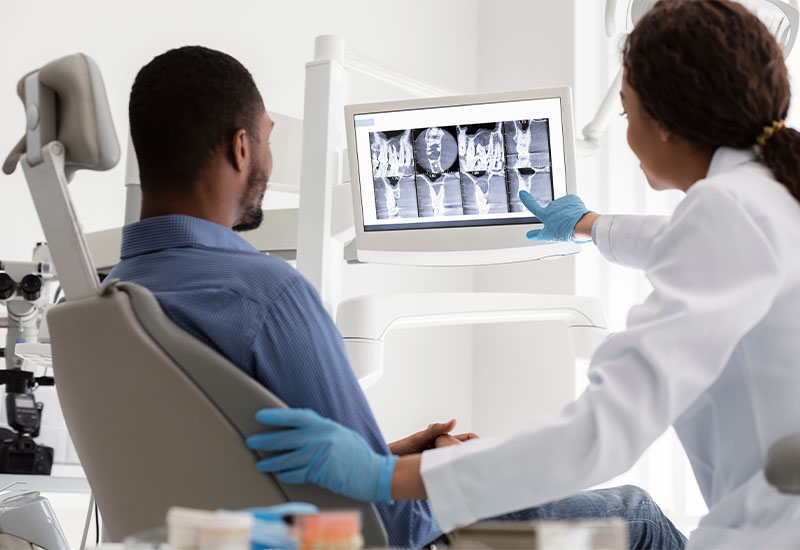
An X ray is taken first, because the decision and the difficulty both depend on the shape of the roots and how close they lie to the nerve running through the lower jaw or the sinus above the upper. The removal itself is done under local anaesthetic. The practice describes this treatment as painless.
For an impacted tooth the gum is lifted, a small amount of bone may be removed, and the tooth is often divided into sections so it can be taken out through a smaller opening than the whole tooth would need. The socket is cleaned and stitched. You feel pressure and hear noise throughout, which is normal and is not the same as pain.
Visits, Recovery and When to Call
Visits and timing
Usually one appointment. It may cover one tooth, one side, or all four depending on what is planned. Allow more time than a routine visit, and arrange to have the rest of the day free rather than going straight back to work.
Afterwards
Swelling and stiffness peak around day two and then settle over about a week. Ice for the first day, soft food, and salt water rinses starting the day after. Avoid smoking, straws and vigorous rinsing for the first twenty four hours. Difficulty opening the mouth fully for a few days is common.
Call sooner if
Pain increases from day three onwards, which often means a dry socket, bleeding restarts and does not stop under firm pressure, swelling is still growing after day three or is accompanied by fever, or the lip, chin or tongue is still numb the following day.
Getting the recovery right
The clot in the socket is what the healing is built on. Most complications after wisdom tooth removal come from losing it early, and the three usual causes are smoking, suction from a straw and rinsing hard on the first day. Eat properly, on the other side, rather than not eating at all, and take any prescribed medication on the schedule you were given rather than only when it starts to hurt.
Keep reading
Questions About Wisdom Tooth Extraction?
Describe the problem on the phone. That conversation is usually enough to work out the first appointment. Mandarin, Taiwanese, English and Japanese are spoken.